
Choosing Between Specialty, Commercial, and Hybrid Cafe Models | Coffee Business Insights
Learn how to choose between specialty, commercial, and hybrid cafe models based on customer behavior, pricing power, cost pressure, and market fit.
STRATEGY AND CONCEPT
Paulo Abiog - Coffee and Cafe Business Consultant
3/28/20268 min read
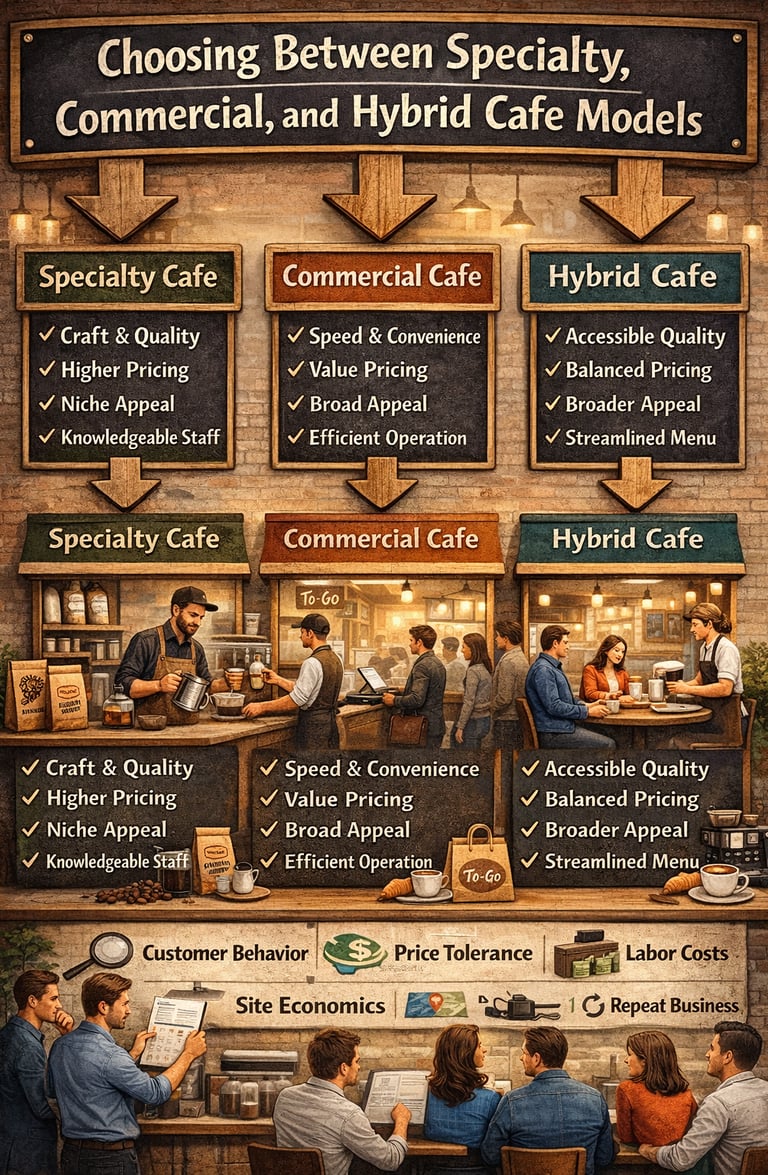
Choosing the right cafe model is not a branding decision alone. It is a business-model choice shaped by customer behavior, pricing tolerance, cost pressure, site economics, and long-term scalability.
Choosing a cafe model is one of the most important decisions a founder, investor, or operator will make. Yet it is often treated as a matter of taste, branding, or aspiration instead of commercial fit.
Many businesses start by asking whether they want to look premium, mainstream, or “specialty.” The more useful question is whether the market can support a specialty, commercial, or hybrid model under current operating conditions.
That distinction matters more now because the coffee and cafe business is operating in a less forgiving environment. World coffee prices rose 38.8% in 2024 due largely to adverse weather and supply-side disruption, and the ICO Composite Indicator Price still averaged 296.89 US cents per pound in January 2026. At the same time, restaurant operators continue to deal with elevated labor costs, occupancy pressure, and thin margins. In 2024, median labor costs reached 36.5% of sales for full-service operators and 31.7% for limited-service operators, while median occupancy costs remained above 5% of sales for both.
In that environment, the wrong model choice becomes expensive very quickly.
The strongest cafe businesses are not always the most fashionable. They are the ones whose business model fits the market, the customer, the location, and the operating economics of the business.
What These Three Cafe Models Really Mean
Before choosing between specialty, commercial, and hybrid models, it helps to define them clearly.
A specialty cafe model is built around coffee quality as a core selling point. It usually emphasizes bean origin, roast profile, brewing precision, barista skill, product storytelling, and a more intentional experience. Customers are expected to value craft, differentiation, and quality cues, not just convenience.
A commercial cafe model is built around accessibility, consistency, speed, familiarity, and broad market appeal. It usually prioritizes operational efficiency, recognizable products, easier customer decision-making, and pricing that supports wider adoption. Coffee still matters, but the business is designed to reduce friction and increase repeatability.
A hybrid cafe model sits between the two. It borrows the quality cues and brand credibility of specialty coffee while adopting the accessibility, clarity, and operational discipline of a more commercial model. In many markets, this has become one of the most practical approaches because it allows the business to serve customers who want better coffee without making the concept too narrow, too technical, or too intimidating.
None of these models is automatically superior. The right choice depends on market readiness, customer behavior, trade area, pricing power, and business objectives.
Why This Decision Matters More Now
The gap between a good-looking concept and a viable one has widened.
Coffee costs remain exposed to climate and supply shocks. FAO noted that reduced output and weather stress in major producing countries helped push coffee prices sharply higher, and also warned that prices could rise further if major growing regions face more supply reductions. The ICO’s market data suggests prices remain historically elevated rather than returning to older norms.
At the same time, operating businesses are still dealing with higher labor burdens, cautious consumers, and strong competition around value. The National Restaurant Association’s 2025 data shows labor costs remain well above historical averages, and operators that fail to keep labor and other prime costs under control are much more likely to struggle with profitability.
Retail costs also remain uneven by district. CBRE’s 2025 retail rent analysis found that high-street and live-work-play districts continue to outperform, but pricing growth is uneven and performance varies sharply across corridors, especially in office-adjacent locations.
That means choosing the wrong model is no longer a slow problem. It can become a fast one.
When a Specialty Cafe Model Makes Sense
A specialty model works best when the market is willing to pay attention, pay more, and return for quality rather than convenience alone.
This model makes the most sense when:
The market already understands specialty coffee or is ready to learn
Customers are willing to pay for differentiation
The concept has strong product discipline
The site supports discovery, dwell time, or destination-driven traffic
The operator can maintain consistent quality standards
The business can absorb higher training, product, and service expectations
A specialty cafe model can work well in mature urban districts, design-conscious neighborhoods, and premium mixed-use areas where customers already understand quality signaling. But the model is strongest when the category is deep enough to support repeat demand, not just curiosity.
A Realistic Scenario
A founder opens a specialty-led cafe in a district where customers already seek independent brands, are comfortable paying more, and actively notice product differences. The menu is curated, the service is deliberate, and the location benefits from destination traffic.
In that environment, the specialty model can work because the market does not need to be convinced that quality matters.
Where Specialty Models Go Wrong
The specialty model becomes risky when founders confuse admiration with repeat demand.
A market may respect specialty coffee without buying it frequently enough to support the economics. That happens when the concept is too narrow for the trade area, too expensive for routine purchase, too dependent on customer education, or too slow for the traffic pattern.
A specialty cafe is not only a coffee decision. It is a volume, pricing, and customer-behavior decision.
When a Commercial Cafe Model Makes Sense
A commercial model works best when the market prioritizes convenience, consistency, speed, and broad accessibility.
This model makes the most sense when:
The customer base is large and mixed
Repeat traffic depends on ease and speed
Price sensitivity is high
The site favors transaction volume over dwell time
The business needs stronger predictability and simpler execution
The operator wants broader appeal and easier scaling
This model is especially relevant in commuter corridors, office-led districts, transport-heavy locations, and mass-market residential zones where customers are less interested in product storytelling and more focused on reliable service and acceptable value.
That does not mean commercial means low quality. It means the business is designed to reduce friction.
A Realistic Scenario
A cafe opens in a transport-adjacent district where most customers want a fast drink before work, a familiar beverage later in the morning, or a convenient takeaway purchase in the afternoon. A commercial model with strong consistency, efficient service, approachable pricing, and straightforward menu architecture is more likely to win repeat traffic than a highly specialized concept.
Where Commercial Models Go Wrong
Commercial models fail when they become too generic.
If the concept has no meaningful differentiation, weak brand memory, or poor price-to-value perception, the business can end up trapped in a race to the middle. In competitive markets, convenience alone is not enough unless the brand also delivers trust, speed, and consistency at a level customers can feel.
Why Hybrid Models Are Becoming More Relevant
In many markets, the hybrid model is becoming one of the most commercially realistic options.
A hybrid model usually offers:
Better coffee than the average mainstream chain
Easier accessibility than a highly specialized independent cafe
Pricing that feels more justified than purely premium
A broader menu without excessive complexity
Enough quality credibility to attract coffee-aware customers
Enough simplicity to remain operationally resilient
This model works especially well in markets where specialty coffee interest is growing, but routine buying behavior is still shaped by convenience and value. It is also effective in cities where customers want the language of quality without the friction, slower service, or narrow philosophy that sometimes comes with more purist specialty concepts.
A Realistic Scenario
A founder builds a cafe with solid coffee quality, attractive branding, approachable hospitality, a menu that includes both staple espresso beverages and selected premium items, and a pricing structure that supports repeat visits. Customers who care about coffee feel there is enough quality. Customers who mainly want convenience do not feel excluded.
That hybrid model may outperform a more extreme concept because it fits how the market actually buys.
How to Choose the Right Model for Your Market
The right model is the one that matches real demand, not founder preference.
1. Look at customer behavior, not only category trends
Do not ask whether specialty coffee is growing globally. Ask how customers in your area actually buy.
Are they:
Willing to pay for quality?
Buying for speed or for stay?
Loyal to brands or to convenience?
Price-sensitive or experience-led?
Routine-driven or novelty-driven?
The wrong model often starts with a global trend and ignores local behavior.
2. Evaluate the site honestly
Some sites support specialty better than others. Some support volume better than others. Some only work if the concept is hybrid.
CBRE’s 2025 findings are clear that retail performance varies sharply across corridors and formats, even within the same market. A premium address can still be the wrong address if customer behavior and occupancy burden do not fit the model.
3. Match the menu to the model
A specialty model usually requires tighter menu discipline, stronger product storytelling, and higher consistency standards.
A commercial model usually requires speed, clarity, and easier production flow.
A hybrid model requires careful balance. It cannot be too complicated for mainstream buyers or too diluted for customers who care about quality.
4. Stress-test the labor model
The more service complexity, menu depth, and product sensitivity your concept requires, the harder it becomes to execute under elevated labor costs.
That is why model choice must be operational, not aesthetic. Labor costs remain well above historical averages for restaurant operators.
5. Decide how the business will win repeat purchases
A commercial model usually wins through convenience and familiarity.
A specialty model usually wins through quality and distinction.
A hybrid model usually wins through accessible quality.
The real question is not what sounds good in theory. The real question is what customers will repeat often enough to sustain the business.
The Biggest Mistake Founders Make
The biggest mistake is choosing a model as a matter of identity.
Some founders choose specialty because it feels more credible.
Some choose commercial because it feels safer.
Some choose hybrid because they think it means “something for everyone.”
All three can fail if they are not grounded in real market conditions.
A specialty cafe without enough specialty demand becomes a vanity project.
A commercial cafe without meaningful differentiation becomes forgettable.
A hybrid cafe without clear positioning becomes confused.
The right model is not the most impressive one. It is the one the market can understand, afford, repeat, and sustain.
Final Thought
Choosing between specialty, commercial, and hybrid cafe models is not a branding exercise. It is a business-model decision.
In today’s environment, where coffee prices remain elevated, labor and occupancy continue to pressure margins, and customers are balancing value with experience, the strongest cafe model is the one that fits real customer behavior and real operating conditions.
A specialty model can work if the market is ready.
A commercial model can work if scale, speed, and accessibility matter most.
A hybrid model can work if the market wants better coffee without the friction of a narrow specialty proposition.
The decision should not begin with what the founder wants to be. It should begin with what the market is prepared to buy.
Summary
Choosing between specialty, commercial, and hybrid cafe models is a commercial decision, not just a branding one. Specialty models work best where customers understand and pay for quality differentiation. Commercial models are strongest where speed, familiarity, and broad accessibility matter most. Hybrid models often perform well in markets that want better coffee but still prioritize convenience and value. Current pressures, including elevated coffee prices, high labor costs, occupancy burden, and narrow margins, make model choice more important than ever. The best cafe model is the one that aligns customer behavior, site economics, menu design, and operating reality.
FREQUENTLY ASKED QUESTIONS
What is the difference between a specialty cafe and a commercial cafe?
A specialty cafe focuses more heavily on coffee quality, sourcing, craft, and differentiation. A commercial cafe focuses more on accessibility, speed, familiarity, and broad customer appeal.
What is a hybrid cafe model?
A hybrid cafe model combines elements of specialty and commercial coffee retail. It usually offers better-than-mainstream coffee quality while keeping the concept more approachable, efficient, and easier for a wider audience to buy repeatedly.
Which cafe model is most profitable?
There is no universally most profitable model. Profitability depends on how well the model fits the market, location, pricing tolerance, traffic pattern, and operating structure.
Is specialty coffee always a better business model?
No. Specialty coffee can be a strong model, but only when there is enough demand, pricing tolerance, and execution discipline to support it. In the wrong market, it can become too narrow or too expensive to sustain.
Why are hybrid cafe models becoming more common?
Hybrid models are becoming more common because many markets want better coffee quality without the operational friction or pricing intensity of a pure specialty concept. They can appeal to a broader customer base while preserving stronger quality perception.
How should founders choose the right cafe model?
Founders should start with customer behavior, buying occasions, price sensitivity, site economics, menu complexity, labor realities, and repeat-purchase potential. The model should fit the market, not just the founder’s personal preference.
References / Citations
FAO, Adverse climatic conditions drive coffee prices to highest level in years.
International Coffee Organization, January 2026 public market information and Composite Indicator Price.
National Restaurant Association, labor cost, occupancy cost, and profitability analysis.
CBRE, 2025 Retail Rent Dynamics.
Planning a new cafe, repositioning an existing concept, or evaluating a growth strategy?
The right model choice can protect margins, strengthen repeat business, and improve long-term scalability before capital is wasted.
PAULO ABIOG
Coffee & Café Business Consultant
Core enegagement
contact
hello@consultnow.me
https://consultnow.me
Launch Advisory
Performance Turnaround
Business Replication & Scaling
Fractional Strategic Support