
How to Evaluate a Cafe Location Beyond Foot Traffic | Coffee Business Insights
A busy street does not automatically make a profitable cafe location. The right site is the one where customer behavior, rent, accessibility, traffic quality, and operating economics all support the business model.
STRATEGY AND CONCEPT
Paulo Abiog - Coffee and Cafe Business Consultant
4/11/20268 min read
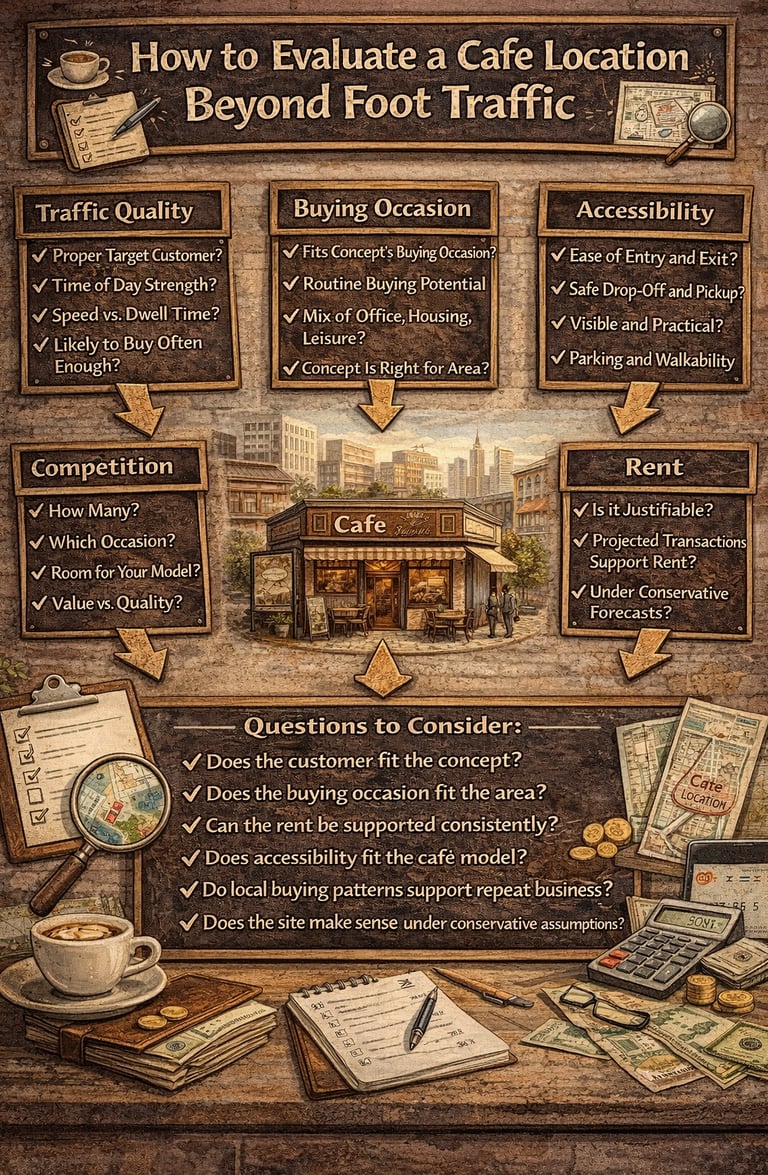
A busy street does not automatically make a profitable cafe location. The right site is the one where customer behavior, rent, accessibility, traffic quality, and operating economics all support the business model.
A lot of cafe founders still make the same mistake: they see a busy corner, assume the foot traffic is enough, and treat the location as solved.
It is not.
Foot traffic matters, but foot traffic alone does not make a site commercially viable. A cafe does not earn revenue from how many people pass by. It earns revenue from how many of the right people stop, buy, return, and do so often enough to cover rent, labor, cost of goods, and operating overhead.
That distinction matters even more now because the operating environment remains difficult. World coffee prices rose 38.8% in 2024 due largely to adverse weather and supply-side disruption, and FAO warned prices could rise further if major growing regions face more production setbacks. At the same time, restaurant operators continue to manage elevated labor costs and narrow margins.
In that environment, a weak location decision becomes expensive quickly. A site can look attractive, feel premium, and still be structurally wrong for the concept.
Why foot traffic is often misunderstood
High pedestrian volume is only useful if the traffic is relevant to the business.
A busy area may include commuters who never stop, tourists who do not repeat, office workers who only buy during narrow peak periods, or passersby who are outside the price tolerance of the concept. A quieter street can outperform a busier one if it attracts the right customer, at the right time, with the right buying pattern. That is why location quality is about traffic fit, not traffic quantity.
The question is not simply, “How many people walk past this site?” The stronger question is, “How many of these people are likely to become repeat customers at the ticket size this model needs?”
Start with traffic quality, not traffic volume
The first thing to evaluate is the quality of the traffic.
You need to understand:
Who is moving through the area
Why they are there
When they are there
Whether they are in a hurry or open to staying
Whether they are likely to buy once, regularly, or not at all
A commuter corridor can look highly attractive because of volume, but if most customers want speed, convenience, and low-friction purchases, a slower dine-in concept may struggle. On the other hand, a mixed-use district with office, residential, and leisure traffic may offer fewer total pedestrians but stronger all-day revenue potential. CBRE’s 2025 retail rent research supports this distinction, showing that live-work-play districts are outperforming broader mixed-use areas in many markets because they align better with how consumers spend time and seek convenience.
A Realistic Scenario
A founder chooses a site because it sits on a very busy road with constant pedestrian movement. But most of that traffic is transit flow: people crossing quickly, heading to work, or moving between transport points. Very few are in a buying mindset. The site looks active, but the conversion potential is poor.
That is not a traffic problem. It is a traffic-quality problem.
Study day-parts, not just daily totals
A location should be evaluated by time patterns, not just total movement.
Many sites look strong when observed at one good hour, then underperform across the rest of the day. A cafe may depend heavily on:
Breakfast rush
Mid-morning office break
Lunch
Afternoon meetings
Evening leisure traffic
Weekend family visits
The wrong location often reveals itself when sales depend too heavily on one short window. If the concept only works during one strong daypart, then rent, labor, and fixed costs become harder to support.
This matters even more in office-led areas. CBRE notes that some high-street business districts still show higher availability than suburban counterparts because work-from-home patterns and uneven office recovery continue to affect retail performance. A site that depends too heavily on office density may look promising on paper but still behave inconsistently in practice.
Match the site to the concept’s buying occasion
A location is only good if it fits the way the concept expects customers to buy.
A commuter-led grab-and-go concept needs:
Speed
Visibility
Easy entry and exit
Clear takeaway flow
Strong morning and midday demand
A specialty-led or community-focused cafe may need:
Dwell-friendly traffic
Destination behavior
Parking or easy access
Stronger weekend or afternoon relevance
Customers willing to stay and spend
A food-led or hybrid cafe may need a broader blend of office, residential, and social traffic.
This is why location cannot be evaluated independently of the model. The same site can be excellent for one format and weak for another. World Coffee Portal’s 2025 market coverage shows that growth continues across regions such as East Asia, Europe, the UK, and the US, but operators are simultaneously facing stronger competition, value pressure, and more selective demand. That means format fit matters more than ever.
Evaluate accessibility, not just visibility
A visible site is not always an accessible one.
Some locations look strong from the street but create friction once a customer tries to use them. A strong cafe site should be tested for:
Parking access
Ease of drop-off or pickup
Walkability
Safe crossings
Frontage clarity
Entry convenience
Accessibility for people with strollers, mobility needs, or short stops
Delivery and rider practicality where relevant
A location with limited parking, hard turns, awkward access, or confusing entry points may convert much less traffic than expected. For cafes, convenience is often more commercial than visibility.
Measure competition the right way
Many founders assess competition too simplistically. They count nearby cafes and stop there.
That is not enough.
You need to evaluate:
Who the direct competitors are
Who else serves the same buying occasion
How competitors price
How fast they serve
What kind of customer they attract
Whether the area is under-served, over-served, or simply crowded with weak offers
A location with several coffee businesses is not automatically a bad site. It may indicate strong demand. But it may also mean the market is already saturated for the customer segment you intend to target. World Coffee Portal’s latest market reports repeatedly highlight how growth continues, but competition is intensifying and value-for-money is becoming a more important differentiator in markets like the UK and US.
A Realistic Scenario
A founder avoids a district because there are already four coffee businesses nearby. But those businesses are all quick-service commercial offers, and the local trade area still lacks a strong dwell-friendly premium daytime meeting space. In that case, the issue is not the number of competitors. It is whether the site still has room for a different buying occasion.
Rent is not a side issue. It is part of the location decision.
A site is not good if the rent breaks the model.
This is one of the most common mistakes in cafe development. Founders fall in love with the address and assume the sales will adjust upward to justify it. Serious operators do the reverse: they start with realistic sales assumptions, then test whether the rent is supportable.
CBRE’s 2025 report makes clear that urban high streets command significantly higher rents than many suburban locations because of experience- and tourism-led demand. But those same districts can also show higher availability and more uneven performance, especially where traffic quality has not fully normalized. That means prestige can come with a meaningful cost penalty.
A site should be tested against:
Projected daily transactions
Realistic average ticket
Labor model
Occupancy burden
Utility and fit-out implications
Expected seasonality
A premium address is not a strategy if the economics do not hold.
Look at repeat behavior, not one-time exposure
The strongest cafe locations support repeat business, not just discovery.
Tourism-heavy sites, transport nodes, or event-driven corridors can generate volume, but volume without repetition can make the business harder to stabilize. A site becomes stronger when it has customers who can form habits:
Office workers nearby
Residents within regular reach
Students with routine patterns
Families or social users with repeat weekend behavior
Destination visitors who return, not just pass once
This is especially important now because consumers are more selective about what they repeat. World Coffee Portal’s 2025 coverage of the UK and US coffee shop markets emphasizes stronger value competition and tougher trading conditions even in growing markets. Repeatability is no longer a bonus. It is central to location quality.
Understand the district’s economic direction
A location is not only about where it is today. It is also about where the district is going.
Evaluate whether the area is:
Gaining residential density
Becoming more office-active or less office-dependent
Improving in safety and walkability
Attracting complementary tenants
Shifting toward higher-value mixed use
Vulnerable to vacancy or declining demand
CBRE’s findings on live-work-play districts are relevant here because they show that areas with dense populations, strong employment, and active residential development are seeing some of the best retail performance. That kind of district often gives a cafe more resilience than one-dimensional locations dependent on a single traffic source.
Stress-test the location under today’s cost pressures
A location that looked viable in a lower-cost environment may be risky now.
Coffee prices remain elevated because of weather and supply disruption. Labor costs remain high by historical standards. Occupancy costs for restaurants were above 5% of sales in 2024, according to the National Restaurant Association. In a margin-sensitive category, those pressures reduce the margin for location error.
That means evaluating a site should include questions like:
What happens if traffic is 20% lower than expected?
What happens if average ticket growth stalls?
What happens if office traffic softens?
What happens if coffee or dairy costs rise again?
Can the location still work if the first six months are slower than planned?
A location is more investable when it survives conservative assumptions, not just optimistic ones.
What founders, operators, and investors should check before committing
Before signing a lease, a serious location review should answer these questions clearly:
Who is the core customer around this site?
Not broadly, but specifically.
What buying occasions are strongest here?
Morning rush, lunch, long-stay work, social meetings, weekend leisure, or something else.
Does this traffic match the concept?
Not every busy site supports every model.
What are the strongest and weakest dayparts?
A good hour does not guarantee a good location.
How accessible is the site in practice?
Visibility is not enough.
Can the rent be supported under conservative assumptions?
A site is not good if the economics only work in the best-case scenario.
What does competition really look like?
Count competitors, but also study their role in the market.
Does this location support repeat purchases?
One-time exposure is not the same as sustainable demand.
Final thought
A cafe location should never be judged by foot traffic alone.
The right site is the one where customer quality, daypart patterns, accessibility, concept fit, rent burden, competitive dynamics, and repeat-purchase behavior all align.
In today’s environment, where coffee prices remain elevated, labor costs are still under pressure, and rents vary sharply by corridor, weak location decisions become harder to recover from. Strong cafe businesses are not built on busy streets alone. They are built on locations that make commercial sense.
That is the difference between a site people notice and a site that actually works.
Summary
Evaluating a cafe location requires more than counting people who walk past the site. The strongest locations align the right customer, the right buying occasion, the right daypart strength, and the right rent structure with the concept’s operating model. Traffic quality matters more than traffic volume, and accessibility often matters more than visibility alone. In today’s higher-cost environment, site selection must also account for elevated coffee costs, labor pressure, and occupancy burden. The best cafe sites are not always the busiest. They are the ones that convert, repeat, and remain economically resilient under realistic assumptions.
FREQUENTLY ASKED QUESTIONS
Is foot traffic enough to choose a cafe location?
No. Foot traffic only matters if the people passing by are likely to stop, buy, and return often enough to support the business model.
What matters more than foot traffic when choosing a cafe site?
Traffic quality, daypart demand, accessibility, concept fit, rent burden, competition, and repeat-purchase potential often matter more than raw volume.
How important is rent in cafe site selection?
Rent is critical. A location is not strong if the sales required to support the rent are unrealistic under normal operating conditions.
Should a cafe always choose a high-visibility corner?
Not necessarily. A highly visible site can still under-perform if access is poor, traffic is low-quality, or the economics are too expensive for the model.
How do you know if a location supports repeat business?
Look for nearby residents, office workers, students, regular destination users, and buying patterns that can become habits rather than one-time visits.
Why are mixed-use or live-work-play districts often attractive for cafes?
Because they can provide more balanced traffic across dayparts and combine residential, office, and leisure demand in ways that support repeat business.
References / Citations
FAO, Adverse climatic conditions drive coffee prices to highest level in years.
National Restaurant Association, Restaurant occupancy costs were more than 5% of sales in 2024.
CBRE, 2025 Retail Rent Dynamics.
World Coffee Portal, East Asia coffee chain market booms as powerhouse China adds 20,000 stores in a year.
World Coffee Portal, Value in the spotlight as competition heats up in £6.1bn UK branded coffee shop market.
World Coffee Portal, Fastest growth in five years for the European branded coffee shop market.
World Coffee Portal, Growth slows in $58.5bn US branded coffee shop market amid unprecedented cost pressures.
Planning a new cafe, reviewing expansion opportunities, or deciding whether a site is worth the rent?
A stronger location decision begins with customer behavior, site economics, and repeatability, not just street activity.
PAULO ABIOG
Coffee & Café Business Consultant
Core enegagement
contact
hello@consultnow.me
https://consultnow.me
Launch Advisory
Performance Turnaround
Business Replication & Scaling
Fractional Strategic Support