What Makes a Coffee Business Bankable to Investors and Partners | Coffee Business Insights
Learn what makes a coffee business bankable to investors and partners, from market fit and unit economics to operational control and due diligence readiness.
GROWTH AND EXPANSION
Paulo Abiog - Coffee and Cafe Business Consultant
4/4/20269 min read
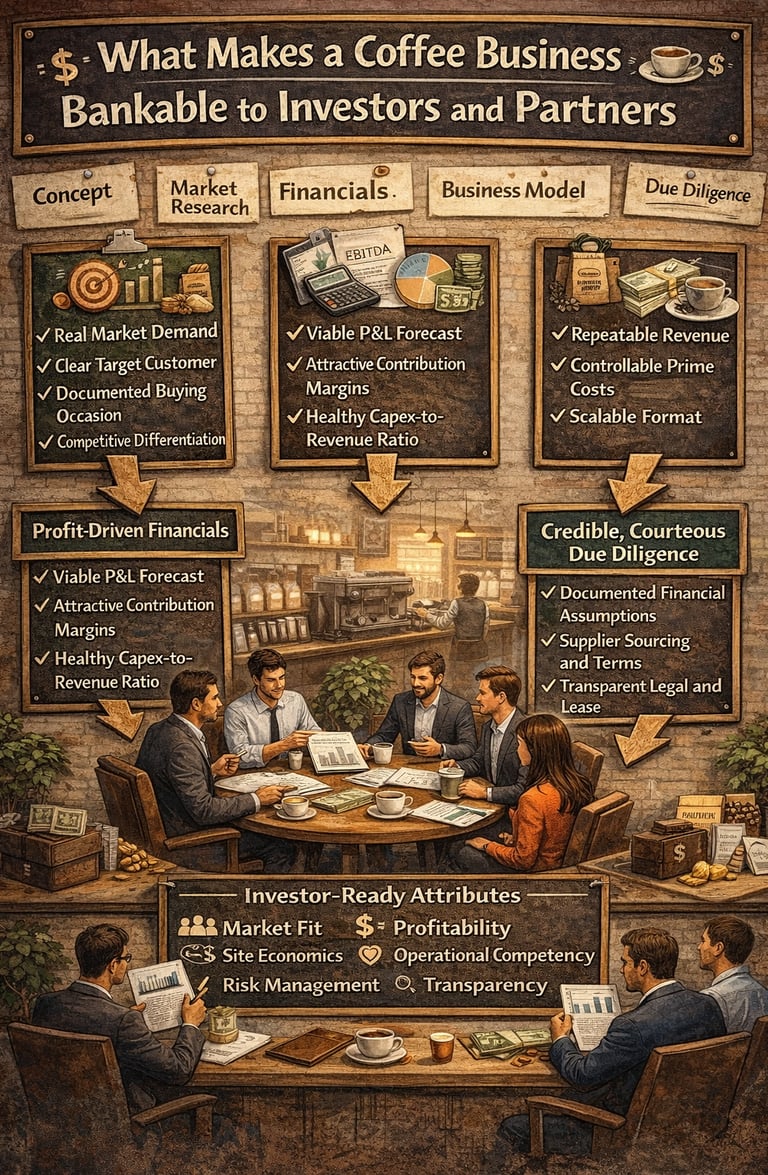
A coffee business becomes bankable when it proves more than passion. Investors and partners look for market fit, repeatable revenue, disciplined unit economics, operational control, and a business model that can withstand today’s cost pressures.
A coffee business does not become bankable because it has a beautiful brand, a strong founder story, or a well-designed cafe. It becomes bankable when it can show that demand is real, the numbers are credible, the risks are understood, and the model can produce repeatable returns.
That distinction matters more now because the operating environment is still difficult. FAO reported that world coffee prices rose 38.8% in 2024 due largely to adverse weather and supply-side disruption, while the International Coffee Organization said its Composite Indicator Price still averaged 296.89 US cents per pound in January 2026. At the same time, restaurant operators continue to deal with elevated labor and occupancy costs, and typical restaurant pre-tax margins remain narrow at around 3% to 5%.
In that environment, investors and serious partners are not simply looking for growth potential. They are looking for resilience, discipline, and proof that the business can perform under pressure. A coffee business becomes bankable when it moves from being an attractive concept to being a credible commercial system.
Bankable does not mean trendy. It means investable.
A bankable coffee business is one that gives capital providers confidence in three things: demand, execution, and returns. In practical terms, that means the business can show a real market, a defendable position, sound unit economics, manageable risk, and a team capable of delivering consistent performance.
This is especially important in coffee because external pressures are no longer minor background issues. Coffee price volatility, higher shipping costs, labor inflation, and uneven retail performance all affect whether a concept can actually protect margin and scale responsibly. Investors know that a strong-looking business can still be financially fragile if those realities are not built into the model.
Real market demand comes first
The first thing that makes a coffee business bankable is not the product. It is proof that the market wants the offer often enough to sustain it.
Investors and partners want to know:
Who the core customer is
What buying occasion the business is built to win
Why that customer will choose this brand repeatedly
How the business is differentiated from alternatives
Whether the addressable market is large enough for the intended format
A business without validated demand is not investable. It is speculative.
That is particularly relevant in a global coffee market that is still growing, but not uniformly. World Coffee Portal reported that the East Asian branded coffee shop market grew 18.4% by outlets over the last 12 months to reach 180,268 stores, while the US branded market reached $58.5bn and more than 45,200 outlets, though operators face a more difficult trading environment as record green coffee costs and value-driven competition intensify. These figures show both opportunity and pressure: growth exists, but investors will expect sharper proof of market fit than they did in easier conditions.
A realistic scenario
Two founders pitch similar coffee businesses. One presents a polished brand, a premium interior concept, and a menu. The other presents customer segmentation, trade area behavior, projected transaction patterns, pricing tolerance, and evidence that the concept fits the location. The second business is far more likely to be viewed as bankable because it shows that demand has been tested, not assumed.
A clear and repeatable business model matters more than a good concept
Investors rarely back coffee businesses just because they like coffee. They back models that can be repeated, understood, and controlled.
That means a bankable coffee business should be able to explain:
How it makes money
What drives repeat purchases
What the margin structure looks like by category
Whether the format is replicable
Whether the economics work at one site before expansion is considered
A business model that depends too heavily on novelty, founder presence, or difficult execution is harder to finance. A bankable model is not necessarily simple, but it is understandable and reproducible.
This is where many coffee businesses lose credibility. They focus heavily on brand, product, and design, but cannot explain store-level economics, expected payback period, contribution margin by product line, or how the model would perform if sales ramp more slowly than expected. Under today’s cost conditions, that gap becomes more concerning to any serious investor.
Strong unit economics are non-negotiable
A bankable coffee business must show that each unit, outlet, or operating format can make sense financially.
At minimum, investors and partners will want confidence around:
Average ticket
Transaction volume
Gross margin by category
Labor efficiency
Rent burden
Capex-to-revenue relationship
Expected payback period
Cash conversion and working capital needs
This matters because restaurant margins remain thin and costs remain elevated. The National Restaurant Association says food and labor costs for the average restaurant have each risen 35% over the last five years, while other expenses such as occupancy, supplies, and processing fees have also climbed quickly. In a business with only a 3% to 5% typical pre-tax margin, weak unit economics are not a small flaw. They are a major investment risk.
A realistic scenario
A coffee business presents strong projected revenue growth, but cannot clearly show how labor, rent, and cost of goods behave at store level. Another presents fewer stores in its growth plan, but has clear site economics, contribution margins, and conservative assumptions. The second business is more bankable because it gives investors something they can underwrite.
Investors back operational control, not just ambition
A coffee business becomes more bankable when it shows that management can control execution.
That includes:
Standard operating procedures
Training systems
Quality control
Inventory discipline
Supplier management
Labor scheduling discipline
Reporting cadence
KPI visibility
If a business cannot control operations, it cannot protect margin. If it cannot protect margin, investors will question the scalability of the model.
This is especially important now because labor remains well above historical averages and operators who let prime costs drift out of line are much more likely to struggle with profitability. For investors, operational weakness is not just a management issue. It is a financial risk.
Site economics and format discipline carry significant weight
A coffee business is more bankable when its format matches its market and its site economics make sense.
Investors will want to know:
Why this format fits this location
How traffic patterns support the model
Whether the rent burden is realistic
Whether the site depends too heavily on narrow peak periods
How sensitive the business is to office traffic, tourism, or residential behavior
CBRE’s 2025 retail rent analysis shows why this matters. Urban high-street space still commands a premium, but availability and rent growth vary widely by corridor. Prime live-work-play districts are outperforming broader mixed-use areas in some markets because they better match how consumers spend time and move through cities. That means prestige alone is not enough. Bankable businesses show that their site choice reflects local demand drivers and format fit, not just image.
Resilient supply and cost planning improve credibility
Coffee businesses are now judged in part by how they handle volatility.
FAO highlighted that weather-related disruption in Brazil, Viet Nam, and Indonesia contributed materially to rising prices, and also noted higher shipping costs as part of the pressure. For an investor, that means a business should not only show what it wants to sell. It should show how it will protect supply, pricing logic, and margin if commodity or logistics conditions move against it.
A more bankable coffee business usually demonstrates:
Supplier diversification
Documented sourcing standards
Menu resilience if coffee or dairy costs rise
Pricing logic grounded in value, not hope
Sensible inventory and procurement planning
In this market, weak supply planning signals weak management discipline.
Credible financial assumptions build trust
One of the fastest ways to lose investor confidence is to present optimistic numbers without credible assumptions.
A bankable business uses disciplined forecasting. It does not assume immediate maturity, perfect labor efficiency, or constant demand growth. It shows conservative scenarios, explains ramp-up timing, and makes clear what assumptions sit behind revenue and cost projections.
That matters because the broader operating environment is still volatile. The US branded coffee shop market continues to grow, but World Coffee Portal says operators face record green coffee costs, tariff concerns, and lower consumer confidence. In Europe, branded coffee shop growth continues, but operators are also reporting high operational costs and concern over record green coffee prices. A lender or equity partner will expect those realities to be reflected in projections.
A realistic scenario
A founder presents a five-store rollout based on aggressive sales assumptions and no downside scenario. Another founder presents a slower expansion plan, lower initial margins, and a sensitivity model showing how the business responds to lower traffic or higher input costs. The second founder is more likely to earn serious investor attention because the forecast reflects reality rather than confidence alone.
Governance, transparency, and due diligence readiness matter
A coffee business becomes more bankable when it is easy to evaluate.
Investors and partners are reassured by businesses that can clearly produce:
Legal documentation
Lease terms
Ownership structure
Financial statements or clean management accounts
Tax and compliance records
Supplier agreements
CAPEX breakdowns
Opening budgets
Operating assumptions
Transparency lowers friction. Businesses that are difficult to diligence often look riskier than they may actually be.
This matters with strategic partners too. A large coffee brand, distributor, landlord, or corporate operator is more likely to engage with a business that is commercially organized and document-ready.
The management team is part of the asset
Investors do not only back concepts. They back management.
A bankable coffee business usually has leadership that can show:
Commercial judgment
Operating competence
Knowledge of the category
Financial discipline
Willingness to adapt
Clarity in decision-making
This does not mean the team must be large. It means it must be credible. If the business is founder-led, investors will ask whether too much of the model depends on one person. If it does, then the business may be admired but not seen as a safe platform for capital.
What makes a coffee business attractive to strategic partners
Partners do not always look for the same things investors do, but there is strong overlap.
A strategic partner is more likely to engage when a coffee business can show:
Market relevance
Clean brand positioning
Operational competence
Dependable demand
Ability to execute consistently
Alignment with the partner’s own brand, supply, or market goals
For example, a landlord may value traffic stability and tenant quality. A corporate foodservice group may value replicability and system discipline. A roaster or FMCG player may value brand credibility and volume potential. In each case, the business becomes more attractive when it is easy to understand commercially and easy to trust operationally.
The biggest mistake founders make
The biggest mistake is assuming that passion, product quality, and design are enough to make the business investable.
They are not.
A coffee business becomes bankable when it shows:
Real demand
Repeatable economics
Operational control
Realistic projections
Resilience under cost pressure
Transparency under due diligence
Without those, a business may still be interesting. But it will struggle to earn serious capital.
Final thought
What makes a coffee business bankable to investors and partners is not hype. It is proof.
Proof that customers want it.
Proof that the numbers work.
Proof that the model can repeat.
Proof that management can execute.
Proof that the business can survive current cost and supply pressures.
In today’s environment, where coffee prices remain exposed to climate shocks, labor costs are still elevated, rents vary sharply by corridor, and restaurant margins remain thin, capital will continue to reward discipline over storytelling.
A bankable coffee business is not simply attractive. It is commercially credible.
Summary
A coffee business becomes bankable when it can prove market demand, repeatable revenue, credible unit economics, operational control, and resilience under today’s cost pressures. Investors and partners are not only looking for growth potential. They are looking for disciplined management, realistic forecasting, clean due diligence, and a model that can survive volatility in coffee pricing, labor, and occupancy. Strong concepts may open doors, but investable businesses are built on proof rather than presentation. In practice, the most bankable coffee businesses are the ones that are easiest to understand, easiest to diligence, and most credible under pressure.
FREQUENTLY ASKED QUESTIONS
What makes a coffee business attractive to investors?
A coffee business becomes attractive to investors when it can demonstrate real market demand, clear unit economics, repeatable revenue, disciplined cost control, and credible growth potential.
Do investors care more about brand or profitability?
They care about both, but profitability and financial credibility carry more weight. A strong brand helps, but investors usually need evidence that the business can generate sustainable returns.
Why do unit economics matter so much in coffee businesses?
Unit economics matter because coffee businesses typically operate in a margin-sensitive environment. High labor costs, elevated input prices, and rent pressure mean weak store-level economics can quickly undermine growth plans.
Can a small independent coffee business still be bankable?
Yes, if it can prove consistent demand, healthy margins, operational discipline, and a credible path to stable returns. Bankable does not necessarily mean large. It means investable.
What do strategic partners usually look for in a coffee business?
Strategic partners often look for market fit, operational competence, brand clarity, consistent execution, and alignment with their own commercial objectives.
What is the biggest mistake founders make when raising capital?
The biggest mistake is relying too heavily on vision, product passion, or design while failing to prove demand, economics, and operational readiness.
References / Citations
FAO, Adverse climatic conditions drive coffee prices to highest level in years
International Coffee Organization, January 2026 public market information and Composite Indicator Price
National Restaurant Association, labor cost, inflation, and profitability analysis
CBRE, 2025 Retail Rent Dynamics
World Coffee Portal, East Asia, US, and Europe branded coffee shop market reporting
Planning to raise capital, attract partners, or make your coffee business more investor-ready?
The strongest advantage is not ambition alone. It is a business model that can prove demand, protect margin, and withstand scrutiny.
PAULO ABIOG
Coffee & Café Business Consultant
Core enegagement
contact
hello@consultnow.me
https://consultnow.me
Launch Advisory
Performance Turnaround
Business Replication & Scaling
Fractional Strategic Support