
How to Build a Cafe Concept That the Market Will Actually Buy
A cafe concept is not successful because it looks good in a presentation. It succeeds when the right customers buy it repeatedly, at a price the business can sustain, under real market conditions.
STRATEGY & CONCEPTBRAND & MARKET POSITIONINGPROFITABILITY & FINANCEOPERATIONS & SYSTEMS
Paulo Abiog, Coffee & Cafe Business Consultant
3/23/202610 min read
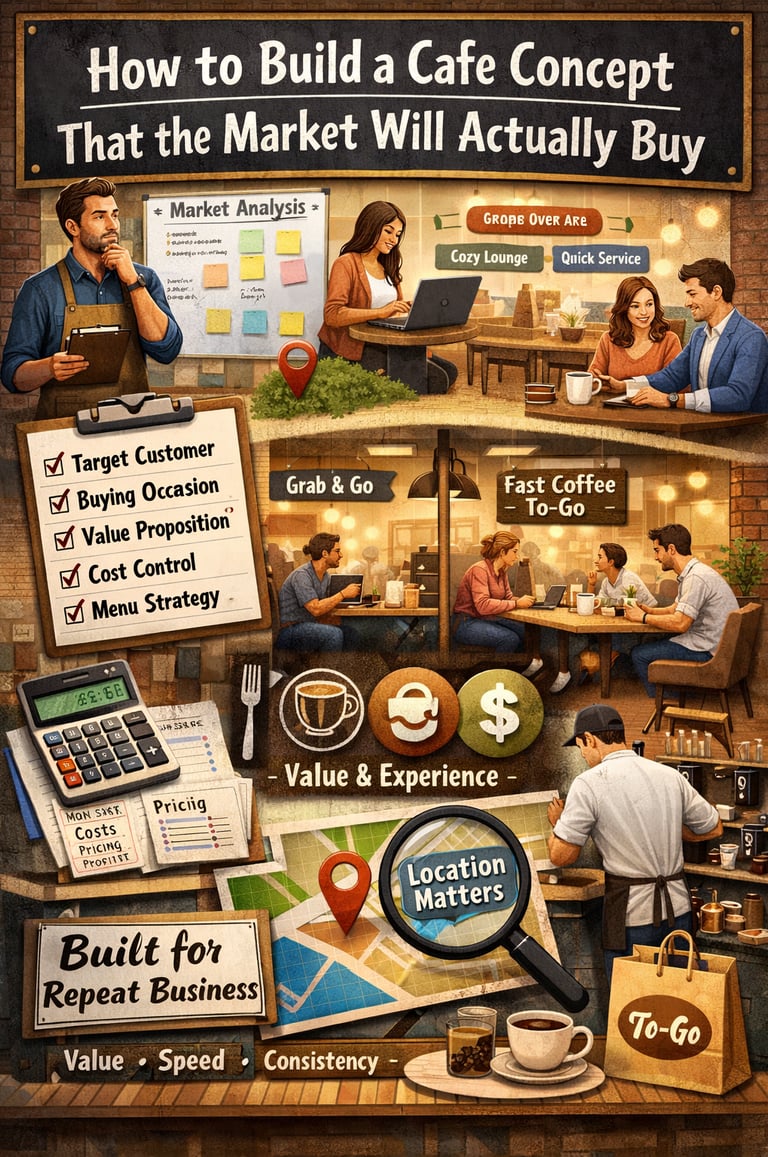
A cafe concept should not be judged by how attractive it looks in a pitch deck. It should be judged by whether the market will buy it repeatedly, at a price the business can sustain, under real operating conditions.
That standard matters more now because the environment is less forgiving than many founders assume. World coffee prices rose 38.8% in 2024, largely because of adverse weather and supply-side disruption, and the ICO Composite Indicator Price still averaged 296.89 US cents per pound in January 2026. At the same time, restaurant operators continue to deal with elevated labor costs, occupancy pressure, and intense competition, while customers are still balancing value and experience in how they choose where to spend.
A concept the market will actually buy is not simply well designed. It is commercially coherent. It fits customer behavior, site economics, price tolerance, service expectations, and the cost reality of the business. That is what separates a concept people admire from a concept people repeatedly choose.
Start with Market Demand, Not Founder Identity
One of the most common mistakes in cafe development is starting with the founder’s taste instead of the market’s behavior.
Many founders ask, “What kind of cafe do I want to build?” The better question is, “What kind of cafe does this market have room for?”
Those are not the same. A founder may want a highly curated specialty concept, design-heavy interiors, premium drink pricing, and a slow, experience-led atmosphere. But if the location is dominated by office workers, commuters, or value-sensitive customers, that concept may be badly misaligned with real demand. The restaurant industry outlook for 2025 shows demand remains resilient, but competition is strong, and operators need to expand customers’ perceived sense of value beyond price alone.
A market-ready concept starts by identifying who the core customer is, what role the cafe plays in that customer’s day, what price band feels reasonable, and whether speed, comfort, convenience, product quality, or atmosphere matters most. Until those answers are clear, the concept is still mostly a guess.
Build Around a Buying Occasion
The market does not buy “coffee” in a generic sense. It buys occasions.
A commuter buys speed and consistency. A remote worker buys space and dwell time. A neighborhood regular buys familiarity and habit. A premium customer buys signaling, product quality, and experience. An office-heavy trade area may buy efficiency, convenience, and reliability.
Strong concepts are built around those occasions, not just around a menu.
This is where many cafe concepts go wrong. The founder finalizes the drinks, the interior, and the branding first, then tries to force the market into the concept afterward. That usually produces weak fit. A concept becomes stronger when the business first decides which customer moment it is built to win, then designs the layout, staffing, service flow, and menu around that moment.
A Realistic Scenario
A founder develops a premium specialty cafe with slower beverage execution, large seating areas, and higher pricing because the goal is to create a destination experience. But the chosen location is dominated by weekday office traffic that needs quick turnover and predictable service. The concept may be attractive. It may even be admired. But it is solving the wrong customer need.
Markets do not reward concepts for being well intentioned. They reward concepts for being relevant.
Define Value the Way Customers Define It
One of the most expensive mistakes in concept creation is assuming that value means low price.
It does not.
Value is what the customer believes is worth paying for. In one market, that may mean affordability and convenience. In another, it may mean quality, service consistency, atmosphere, speed, or social credibility. The National Restaurant Association’s 2025 findings show both sides of that equation: many consumers remain price-conscious, operators plan to use more deals and promotions, and yet many customers still say their dining experience matters more than price alone.
That has major implications for cafe concept design.
A concept the market will buy should define what the customer is truly paying for, what makes that price credible, what encourages repeat visits, and what should be simplified to protect value perception and margin. This becomes even more important when coffee remains expensive by historical standards and weather-related disruption continues to affect supply.
A concept that is vague about value is much harder to price correctly when input costs are already under pressure.
Choose the Format that Fits the Market, Not the Trend
A concept is not only a brand and a menu. It is also a format.
Many cafe businesses underperform because the format does not fit the customer pattern. There may be too much seating in a rush-driven area, too little convenience in a commuter-heavy district, too much complexity for a speed-led location, or too much premium signaling in a category that is still developing locally.
This is why site and format should be developed together.
CBRE’s 2025 retail rent analysis shows that urban high-street locations still command premium rents, but performance varies sharply by corridor, and live-work-play districts are outperforming in some markets because they better match how consumers now spend time and move through neighborhoods. In practical terms, that means the right site is not automatically the most prestigious address. It is the one whose traffic behavior, customer mix, and cost structure align with the concept.
A Realistic Scenario
A founder chooses a high-visibility urban site because it feels credible for the brand. Rent is high, the fit-out is expensive, and the concept assumes long stays and premium average tickets. But the district has uneven office return, limited parking, and demand concentrated into only a few strong dayparts. The result is a concept that looks impressive, but the site economics are working against it from the start.
A market-ready concept respects the fact that format is strategy.
Build the Menu Around Repeatability, Margin, and Speed
A concept customers will buy is not just one they admire once. It is one they understand quickly and return to easily.
That makes the menu a commercial tool, not only a creative one.
A disciplined menu should answer four questions. What brings customers in? What drives contribution margin? What slows service or complicates training? What supports repeat purchasing?
This matters because labor remains expensive by historical standards. National Restaurant Association data shows salaries and wages, including benefits, represented a median 36.5% of sales for full-service respondents and 31.7% for limited-service respondents in 2024, both above historical averages. Operators that let food and labor costs drift too far out of line were much more likely to struggle with profitability.
A menu can look exciting in development and still be commercially weak if it is too labor-heavy, too slow, or too inconsistent to support the intended price point.
A concept the market will buy must also be a concept the team can execute well.
Price for the Real Market, Not the Imagined One
Pricing reveals whether a founder has truly understood the market.
Some businesses under-price because they are afraid of rejection. Others overprice because they want to look premium. Both mistakes come from the same problem: building around aspiration instead of evidence.
The right price is not the one the founder prefers. It is the one the target customer will accept repeatedly relative to perceived value, surrounding alternatives, convenience, experience, product quality, and service reliability.
This is harder now because cost pressure has not disappeared. Coffee remains exposed to climate and supply volatility, while operators are still balancing customer expectations on value with rising labor, occupancy, and other operating expenses. The Association notes that the average restaurant operates on only about a 3% to 5% pre-tax margin, which means pricing errors are costly and not easily absorbed.
A realistic example is easy to recognize. A founder wants to sit at the top end of the market because the beans, design, and brand feel premium. But the surrounding trade area is still anchored by convenience-led chains and mid-market cafes. The concept may be respected, but not repeated often enough. That is not a branding issue. It is a pricing and market-fit issue.
Design the Concept to Survive Current Cost Conditions
A concept the market will buy must also be one the business can afford to operate.
That means stress-testing the model under today’s conditions, not older assumptions. Coffee remains vulnerable to weather-related supply disruption. Labor remains costly. Rent exposure still matters, especially in urban corridors. The National Restaurant Association reports median occupancy costs of 5.7% of sales for full-service operators and 5.2% for limited-service operators in 2024, with urban operators typically carrying higher occupancy burdens.
At the concept stage, that means testing rent tolerance under conservative sales assumptions, labor viability under real service patterns, menu resilience if coffee and dairy costs stay high, dependence on narrow peak hours, product mix flexibility, and working capital needs if ramp-up is slower than planned.
A concept can be desirable to the customer and still be fragile for the operator. The objective is to build one that is both desirable and durable.
Translate Trends, Do Not Copy Them
Global coffee culture is more visible than ever. Founders can study concepts from Melbourne, Dubai, Singapore, London, Seoul, Amsterdam, and New York almost instantly.
That visibility is useful, but it also creates a trap: copying the visible surface of a concept without understanding the market conditions that make it work.
A format that succeeds in one city may depend on higher willingness to pay, stronger office density, greater category maturity, stronger tourism demand, more established takeaway behavior, different labor economics, or different rent structures. Retail performance and consumer patterns vary sharply even within the same country, which is exactly why a copied concept often struggles when transplanted without adjustment.
A Realistic Scenario
A founder imports the visual language and premium menu structure of a successful cafe concept from another region. The store launches with strong social media interest. But local customers treat it as an occasional novelty rather than a habitual purchase. The brand gets attention, but not enough repeat business. That is not a marketing problem. It is a concept translation problem.
A concept the market will actually buy is built from local demand outward, even when the inspiration is global.
Create a Concept Customers Understand Quickly
Clarity sells.
Customers should quickly understand who the cafe is for, what occasion it serves, what price level to expect, what it is known for, and why it deserves repeat visits.
If the concept needs a long explanation, the market will often move on faster than the founder expects.
This matters even more in crowded categories. Demand may be resilient, but resilient demand also attracts more competition. The strongest cafe concepts are not always the most original-looking. They are often the ones with the clearest role in the customer’s routine and the clearest value proposition.
Build for Repeat Behavior, Not Opening-Week Excitement
A cafe concept should not be designed only to impress at launch. It should be designed to be chosen repeatedly.
That means the real test is not buzz. It is habit formation.
A concept the market will buy consistently usually has a clear routine fit, approachable repeat-purchase items, reliable service speed, operational consistency, a price-to-value relationship customers trust, enough distinction to be remembered, and enough discipline to avoid confusing the proposition.
This is where many founders overestimate novelty and underestimate repeatability. Social visibility may create interest. Habit builds the business.
What Founders, Investors, and Operators Should Answer Before Committing Capital
Before committing to a concept, the business should be able to answer these questions clearly:
Who is the exact customer?
Not a vague demographic, but a usable behavior-based profile.
What buying occasion are we built to win?
Morning rush, neighborhood routine, office convenience, destination experience, or something else.
What format best serves that occasion?
Dine-in, grab-and-go, hybrid, kiosk, food-led, or community-led.
What does value mean in this market?
Price, speed, quality, atmosphere, hospitality, or some combination.
Can the site support the concept’s economics?
Not just visually, but through realistic daily transactions and rent tolerance.
Can the menu be executed at the intended price point?
With real labor conditions, real training needs, and real margin targets.
Will customers return often enough?
A market can admire a concept without sustaining it.
Those are not secondary questions. They are the concept.
Final Thought
A cafe concept that the market will actually buy is not built by starting with what the founder wants to express.
It is built by understanding what the market is prepared to choose, pay for, and repeat.
That does not make the process less creative. It makes it commercially intelligent.
In today’s environment, where coffee remains exposed to climate and supply shocks, labor costs are still above historical norms, and customers continue to weigh both value and experience, the strongest concept is not necessarily the most fashionable one. It is the one that fits customer behavior, fits the site, fits the price band, and fits the operating reality of the business.
That is the difference between a cafe concept people admire and a cafe concept the market will actually buy.
Summary
A strong cafe concept starts with market demand, not founder preference. It should be built around a clear buying occasion, a realistic definition of value, the right format for the location, and a menu that supports repeatability, speed, and margin. Pricing should reflect what the market will actually accept, not what the founder wishes were possible. In today’s environment, elevated coffee prices, higher labor costs, and occupancy pressure make weak concepts more vulnerable before they even mature. The best concepts are not simply attractive. They are understandable, repeatable, and durable.
Frequently Asked Questions
What makes a cafe concept commercially viable?
A commercially viable cafe concept is one that fits real customer behavior, local pricing tolerance, site economics, and the operating structure needed to deliver the experience consistently.
Should cafe concepts start with branding or market research?
They should start with market research. Branding becomes more effective once the business knows who the customer is, what occasion it is serving, and what value the market is willing to buy.
Why do many cafe concepts fail even when they look premium?
Because visual quality does not guarantee market fit. A concept can look premium but still be mismatched to the location, price expectations, traffic pattern, or service needs of the customer.
How important is location when building a cafe concept?
Location is critical because it affects rent, customer type, transaction flow, dwell time, accessibility, and how the concept performs financially. A prestigious site is not always the right one.
How should cafe owners think about pricing today?
Pricing should be based on customer willingness to pay, perceived value, nearby alternatives, and actual operating costs. That matters even more now because coffee, labor, and occupancy costs remain under pressure.
What is the biggest mistake founders make when building a cafe concept?
The biggest mistake is building around personal taste or trends before validating customer demand, site fit, and commercial viability.
References
FAO, “Adverse climatic conditions drive coffee prices to highest level in years.”
International Coffee Organization, January 2026 market information and Composite Indicator Price.
National Restaurant Association, 2025 State of the Industry and related research on value, competition, labor costs, occupancy costs, and profitability.
CBRE, “2025 Retail Rent Dynamics.”
Planning a new cafe, repositioning an existing one, or evaluating whether a concept is commercially viable?
The concept stage is where the most expensive mistakes can still be prevented. Strategic clarity around market fit, format, pricing, and operating model can make the difference between a concept that looks good and one the market is actually willing to buy.
Or email directly at hello@consultnow.me