The Hidden Costs of Opening a Cafe in the Wrong Area
A weak cafe location does not only reduce sales. It quietly increases labor pressure, wastes marketing spend, weakens repeat business, strains pricing, and makes every operational mistake more expensive.
GROWTH & EXPANSIONSTRATEGY & CONCEPTPROFITABILITY & FINANCE
Paulo Abiog, Coffee & Cafe Business Consultant
4/18/20269 min read
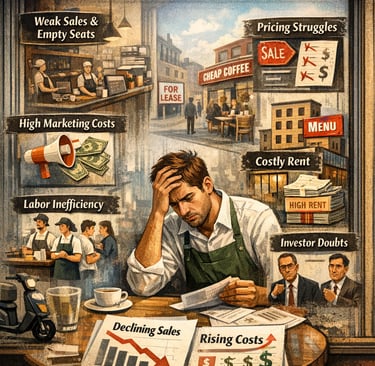
A lot of cafe founders think the biggest cost of opening in the wrong area is weak sales.
It is not.
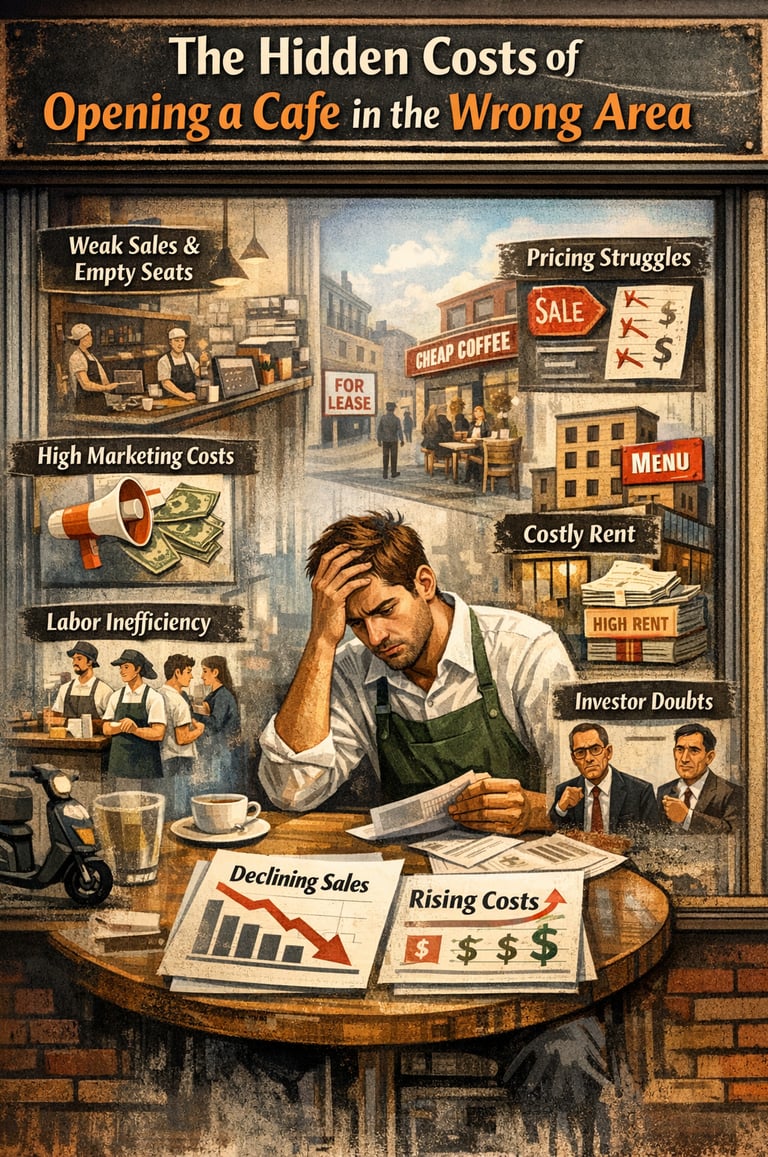
Weak sales are only the visible outcome. The real damage is broader and more expensive. The wrong area does not just reduce traffic. It changes the entire economics of the business. It affects pricing power, labor efficiency, customer retention, marketing efficiency, delivery performance, rent tolerance, and the business’s ability to build routine demand.
That matters even more now because the operating environment is already under pressure. FAO reported that world coffee prices rose 38.8% in 2024 due largely to adverse weather and supply-side disruption, and warned that prices could rise further if major growing regions face additional supply reductions. The International Coffee Organization said its Composite Indicator Price still averaged 296.89 US cents per pound in January 2026, which means operators are still working in a high-cost coffee environment.
At the same time, labor costs remain elevated by historical standards, with the National Restaurant Association reporting median 2024 labor costs of 36.5% of sales for full-service operators and 31.7% for limited-service operators. Occupancy costs also remained above 5% of sales, and urban operators typically carried higher occupancy burdens. In that environment, a poor location choice becomes much harder to absorb.
The wrong area makes revenue harder than it should be
The most obvious cost of the wrong area is that the market around the store does not naturally support the concept.
A location may be busy, visible, or prestigious, but if the surrounding traffic is wrong for the offer, the business starts from a disadvantage. A premium specialty cafe in a value-driven district may struggle to justify its pricing. A slow, experience-led cafe in a commuter-heavy corridor may fail to convert enough time-poor customers. A grab-and-go concept in a destination-led leisure area may leave money on the table because the format does not match how people want to use the space.
This is why location is not only about foot traffic. It is about traffic fit, buying occasion, and repeat potential. CBRE’s 2025 retail rent research notes that live-work-play districts are outperforming in many markets because they better align with how consumers spend time and seek convenience, while some office-dependent corridors still show uneven performance.
The wrong area weakens repeat business
Many cafe businesses survive not because they are discovered once, but because they become part of someone’s routine.
That is where the wrong area becomes especially expensive. If the district is dominated by one-time visitors, low-frequency tourists, unpredictable passersby, or traffic that only appears during a short day-part, the business has to work much harder to replace the stability that repeat customers provide. A site can look active and still be structurally weak if it does not support habit formation.
This matters in today’s coffee market because competition is stronger and consumers are more selective about where they spend. In the UK branded coffee shop market, World Coffee Portal reported that operators are increasingly focusing on value-for-money as price-conscious consumers have more coffee shop choices than ever, while US operators are also dealing with tougher trading conditions and rising cost pressure. In that kind of environment, repeat business becomes more valuable, not less.
A Realistic Scenario
A founder opens in a fashionable mixed-use district because the area looks premium and well branded. The launch gets attention, but most customers are occasional visitors rather than routine users. The business stays visible but never becomes habitual. Over time, sales feel inconsistent, and the operator keeps chasing new customers instead of building a stable base.
That is not just a sales issue. It is a location-structure issue.
The wrong area raises customer acquisition costs
A strong area does some of the commercial work for the business. A weak area forces the business to compensate.
That usually shows up in marketing. When the surrounding trade area does not naturally support the concept, the brand has to spend more to educate the market, attract the wrong-fit customer into trial, or constantly replace low repeat traffic. That means promotions become more tempting, paid media has to work harder, and opening buzz fades faster because the underlying market was never aligned.
This becomes even more dangerous when the broader market is already under cost pressure. World Coffee Portal’s 2025 reporting on the US branded coffee shop market says operators are facing record green coffee costs, inflation, tariff pressure, and lower consumer confidence, while UK operators are also dealing with high operational costs, wage pressure, and energy burden. When acquisition gets more expensive in an already pressured environment, location mistakes become harder to recover from.
The wrong area forces pricing tension
A lot of founders assume pricing is mainly about brand position or menu cost. It is not. Pricing is also about local purchasing behavior.
If the area is price-sensitive, competition is heavily value-driven, or the district does not support the concept’s perceived level of quality or experience, the business faces constant pricing tension. It may be forced to under-price relative to its cost structure, or it may hold pricing and struggle to generate enough repeat demand.
That pressure is especially serious now because coffee input costs remain elevated. FAO’s 2025 coffee market analysis tied the 2024 price surge to reduced output in Vietnam and Indonesia, adverse weather in Brazil, and higher shipping costs. That means pricing mistakes are more dangerous because the cost base is already less forgiving.
A Realistic Scenario
A founder builds a premium cafe in an area where surrounding offers are convenience-led and mid-market. The business wants to charge at the top end of the local range to support better ingredients, design, and service. But local buying behavior does not consistently reward that price level. The result is constant discount temptation, weaker margins, and confusion about what the brand is supposed to be.
The wrong area makes labor less efficient
A poor location affects labor in ways founders often miss.
If trade is concentrated into a very narrow peak, staffing becomes harder to optimize. If the area does not generate predictable repeat behavior, labor planning becomes reactive. If traffic is inconsistent, the team may be overstaffed during weak periods and understaffed during short bursts. If the concept is mismatched to the area, staff may spend more time explaining the offer than serving routine demand.
That matters because labor costs remain well above historical averages. The National Restaurant Association’s 2025 data shows labor still takes an elevated share of sales, and operators who fail to manage prime costs are much more likely to see profitability deteriorate. A weak area does not just hurt top-line sales. It makes the labor line less efficient too.
The wrong area increases the cost of rent relative to reality
A site can be expensive in two ways.
The first is obvious: headline rent is high.
The second is more dangerous: the rent looks acceptable on paper, but is expensive relative to what the area can actually support for that concept. This is where founders get trapped. They choose the address first, then try to force the sales to justify it later.
CBRE’s 2025 retail rent analysis shows that urban high streets and prime corridors still command significant rent premiums, but performance varies sharply across sub-markets, especially where office recovery is uneven or where the local mix no longer supports old assumptions about demand. A prestigious area can still be a financially wrong area.
The rent problem gets worse when margins are already thin. With occupancy costs above 5% of sales for many operators and urban sites often carrying even higher burdens, a location that under-performs on conversion or repeat traffic turns occupancy from a manageable line item into a structural weakness.
The wrong area limits format fit
Not every district supports every model.
A specialty-led, slower, destination-style cafe needs a different area than a commercial grab-and-go format. A food-led hybrid cafe needs different traffic than a small coffee counter built around speed. A residential neighborhood location performs differently from an office-led district, and both behave differently from tourism-heavy areas.
This is why “wrong area” is not only about weak demand. It is often about a mismatch between the concept and the context. World Coffee Portal’s 2025 coverage of the UK and US markets shows that operators are increasingly competing on value, format, and convenience, while fast-growing markets in East Asia continue to expand through different consumer behaviors and retail patterns. The wrong area is often the area that supports a different model better than yours.
The wrong area reduces investor confidence
A weak location decision is not just an operating problem. It is also an investment problem.
Investors and partners increasingly want to see that the site choice reflects customer behavior, realistic traffic conversion, and defensible economics. A location chosen mainly for image, prestige, or founder preference signals weak commercial discipline. In a market where coffee costs remain volatile and operators are under constant cost pressure, weak location logic makes the whole business look less credible.
A bankable cafe business shows that the area fits:
the concept
the target customer
the expected day-parts
the rent model
the repeat-purchase logic
the margin structure
Without that, the location becomes a hidden liability long before the financial statements fully reveal it.
The wrong area creates operational drag across the business
One of the least discussed costs of the wrong area is operational drag.
The business spends more time compensating for structural weakness:
more promotions to stimulate weak periods
more menu adjustments to fit customer mismatch
more pressure on staff to sell harder
more delivery dependence if walk-in demand disappoints
more rethinking of hours, staffing, and product mix
more energy spent fixing a site that never truly fit
This drag is expensive because management attention is finite. Instead of improving systems, building guest loyalty, or scaling a winning model, the operator spends time solving avoidable location problems.
What founders should evaluate before committing to an area
Before opening in any district, the business should answer these questions clearly:
Who is the actual customer in this area?
Not the aspirational customer, but the real one.
What buying occasions dominate here?
Morning rush, lunch, dwell time, social meetings, weekend leisure, or one-off visits.
Does the concept match those occasions?
A good concept in the wrong area is still a weak opening decision.
Can the pricing realistically work here?
Not in theory, but in routine behavior.
Can repeat business form in this district?
Without repeat demand, the business becomes far more fragile.
Does the rent make sense under conservative assumptions?
Not just on a strong-sales day.
What happens if traffic is lower or more inconsistent than expected?
A serious site decision should survive downside assumptions.
Final Thought
The hidden costs of opening a cafe in the wrong area are rarely hidden for long.
They show up in weaker repeat business, harder customer acquisition, pricing tension, labor inefficiency, lower investor confidence, and constant operational compensation. By the time the founder sees the financial impact clearly, the real mistake usually happened much earlier, when the area was chosen for image, convenience, or optimism rather than market fit.
In today’s environment, where coffee prices remain elevated, labor costs stay high, rents vary sharply by corridor, and competition is intense, the wrong area does not just hurt growth. It quietly undermines the whole model.
A cafe can survive a weak month. It struggles much more to survive a structurally wrong location.
Summary
Opening a cafe in the wrong area creates far more than a sales problem. It weakens repeat business, raises customer acquisition costs, increases pricing tension, reduces labor efficiency, strains rent economics, and makes the whole business harder to stabilize. These hidden costs are more dangerous today because coffee prices remain elevated, labor costs are still above historical norms, and occupancy burdens remain meaningful, especially in urban sites. The best area is not simply the busiest or most prestigious. It is the one where customer behavior, buying occasion, pricing, repeat potential, and cost structure all align with the concept.
Key Takeaway
A wrong area does not only lower sales. It increases the cost of everything else the business has to do to compensate for poor market fit.
Frequently Asked Questions
What is the biggest hidden cost of opening a cafe in the wrong area?
The biggest hidden cost is not just weak sales. It is the combined effect of lower repeat business, inefficient labor, weaker pricing power, and higher customer acquisition costs.
Can a busy area still be a bad cafe location?
Yes. A busy area can still be a poor fit if the traffic is low quality, the buying occasions do not match the concept, or the rent is too high for realistic conversion levels.
Why does the wrong area increase marketing costs?
Because the business has to work harder to create demand that the local market does not naturally support. That often means more promotions, more paid visibility, and more effort to replace weak repeat traffic.
How does the wrong area affect pricing?
It can force a business into constant tension between what the concept needs to charge and what the local market is willing to pay regularly.
Why is repeat business so important in location choice?
Because repeat customers stabilize revenue, improve labor efficiency, and reduce the cost of acquisition. Areas that do not support routine demand make the business more fragile.
Does the wrong area also affect investor interest?
Yes. Investors and partners usually want evidence that the site reflects market fit, credible economics, and repeat-purchase potential. A weak area choice can reduce confidence in the whole business.business.
References
FAO, Adverse climatic conditions drive coffee prices to highest level in years.
International Coffee Organization, January 2026 Coffee Market Report and public market information.
National Restaurant Association, Restaurant labor costs are well above historical averages and related profitability analysis.
National Restaurant Association, Restaurant occupancy costs were more than 5% of sales in 2024.
CBRE, 2025 Retail Rent Dynamics.
World Coffee Portal, Growth slows in $58.5bn US branded coffee shop market amid unprecedented cost pressures.
World Coffee Portal, Value in the spotlight as competition heats up in £6.1bn UK branded coffee shop market.
Planning a new cafe, reviewing a site, or deciding whether a district is worth the rent?
Strong location decisions come from customer behavior, repeat potential, and economic fit, not just visibility or optimism.
Or email directly at hello@consultnow.me