
Why Most Cafe Concepts Fail Before Opening
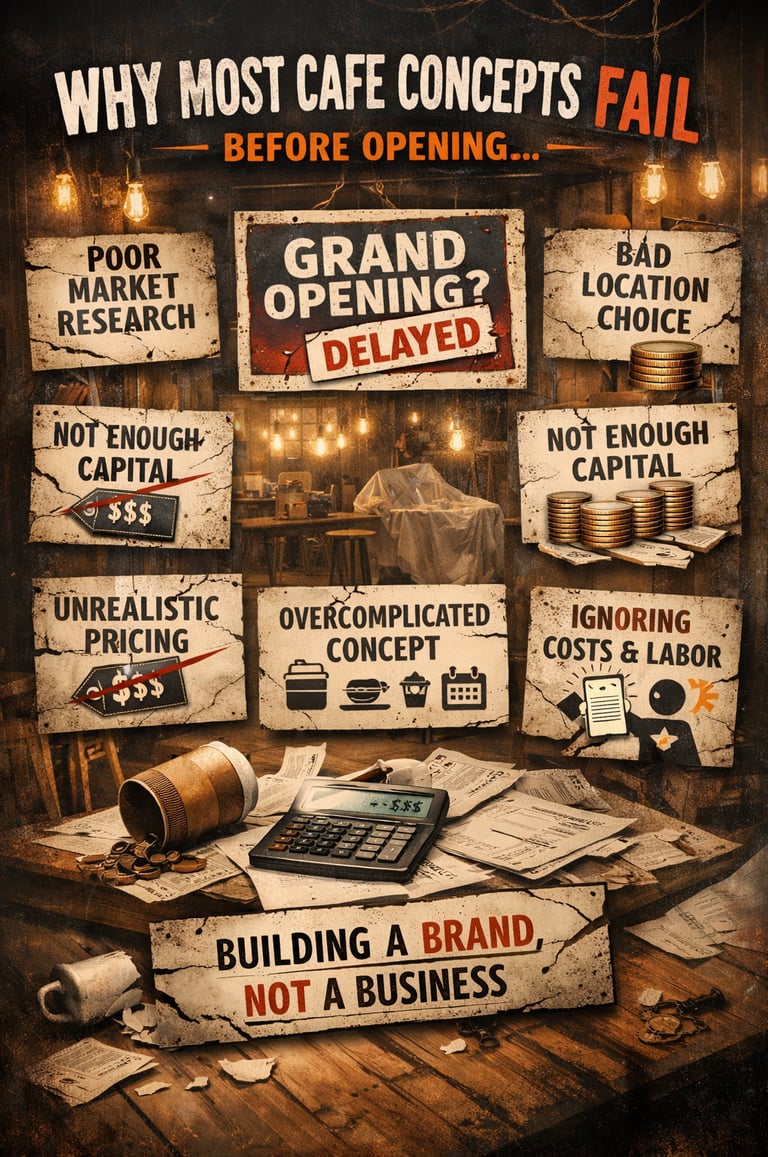
Many cafe concepts fail before the first customer arrives. This article explains the real reasons, from poor market fit and emotional site selection to weak financial planning, unrealistic pricing, and overbuilt concepts.
STRATEGY & CONCEPTBRAND & MARKET POSITIONINGOPERATIONS & SYSTEMSPROFITABILITY & FINANCE
Paulo Abiog, Coffee & Cafe Business Consultant
3/16/20268 min read
Opening a cafe is often seen as a creative and commercially attractive move. In many markets, coffee remains a compelling category because it combines lifestyle appeal, recurring consumer demand, and strong brand-building potential. For founders, investors, and established operators, the category can appear highly scalable.
Yet many cafe concepts fail before they ever begin trading.
This failure rarely results from a lack of enthusiasm, visual ambition, or product interest. More often, it occurs because the concept was developed as a brand idea rather than as a commercially viable business model.
That distinction matters more than ever. Rising input costs, labor pressure, rental exposure, supply-side instability, and increasingly selective consumer behavior have made cafe development far less forgiving. In this environment, weak concepts are often exposed before launch, not after.
The Core Problem: Founders Build the Brand Before They Build the Business
Most unsuccessful cafe concepts are built from the outside in.
The founder begins with atmosphere, design direction, menu vision, and brand identity. These elements matter, but they do not determine viability on their own. A credible concept must also answer a more demanding set of commercial questions:
Who is the target customer?
What demand pattern supports this concept?
What pricing structure is realistic for the market?
What transaction volume is required to break even?
Can the proposed location support those numbers?
· How exposed is the business to wage pressure, cost volatility, and operational inefficiency?
When these questions are not addressed early, the concept becomes vulnerable. The visual identity may be strong, but the business case remains weak.
A cafe concept becomes risky when it is emotionally persuasive but commercially unproven.
Poor Market Validation Is Still the Biggest Reason Concepts Fail Early
One of the most common causes of pre-opening failure is inadequate market validation.
A concept may look compelling in presentation but still be misaligned with local demand. This often happens when founders rely on assumptions rather than evidence. A neighborhood may appear affluent, but that does not automatically mean customers will support a premium cafe model. A city may have an emerging coffee culture, but that does not necessarily mean the market is deep enough for a specialized or high-cost format.
In mature coffee cities, the issue is often oversaturation and weak differentiation. In emerging markets, the issue is frequently misreading how much of the market truly values quality over convenience, familiarity, or affordability. In fast-growth urban markets, founders may launch too early into segments that appear fashionable but are not yet commercially deep enough to sustain the intended price point.
A cafe does not need universal appeal to succeed. It does, however, need a clearly defined audience with repeatable buying behavior.
A Realistic Scenario
A founder develops a design-led specialty cafe in a premium district because the area appears aligned with the intended brand image. Drinks are priced at the upper end of the local market, the fit-out is expensive, and the concept assumes customers will stay, work, and spend.
In reality, the district is dominated by time-constrained customers who prioritize speed and convenience. The concept itself may not be flawed in principle. It is simply misaligned with the actual market behavior of that location.
This is how many cafe concepts fail before opening: not through dramatic collapse, but through a quiet mismatch between the concept and the market it is meant to serve.
Location Is Often Chosen Emotionally, Not Strategically
Location selection remains one of the most misunderstood decisions in cafe development.
A good location is not simply a visible or busy one. It is a location where the right customer, at the right times, with the right buying behavior, can support the economics of the concept. That includes rent, occupancy costs, conversion, repeat traffic, staffing requirements, and operating hours.
Many founders focus on:
Prestige
Foot traffic
Visibility
Neighborhood image
But they fail to test:
Daypart demand
Accessibility and parking
Takeaway versus dine-in behavior
Office or residential dependency
Transaction speed requirements
Seasonal volatility
Rent as a percentage of realistic sales
A visually attractive site can damage a weak model faster than an average one. High-rent mistakes are especially dangerous because they lock poor assumptions into long-term fixed costs.
Under-capitalization Remains One of the Fastest Routes to Failure
Undercapitalization remains one of the most common reasons cafe concepts fail before opening.
The issue is not always the total amount of money available. In many cases, it is the way capital is allocated. Founders frequently overinvest in fit-out, furniture, design, and opening presentation while underestimating the importance of working capital, slower-than-expected ramp-up, early operational instability, and the cost of correcting initial inefficiencies.
They plan for:
Fit-out
Equipment
Opening inventory
Signage
Launch marketing
But they underplan for:
Working capital
Slower-than-expected sales ramp-up
Staff inefficiency in the first months
Wastage during training and menu adjustments
Supply price increases
Permit or contractor delays
Cash tied up in inventory and pre-opening commitments
A Realistic Scenario
A concept spends heavily on architecture, custom furniture, premium branding, and imported design elements. The result is visually impressive and marketable. However, working capital is thin, early sales underperform relative to projections, and the team requires more time to stabilize execution.
Before the business has a fair opportunity to mature, cash pressure forces menu changes, weaker staffing decisions, and reduced consistency. The concept did not fail because it lacked appeal. It failed because it was financially fragile from the outset.
Many Concepts Are Priced for Aspiration, Not Reality
Pricing is one of the clearest indicators of whether a concept has been built on evidence or optimism.
Some founders price too low because they fear resistance. Others price too high because they want the business to appear premium. Both mistakes come from the same underlying issue: the concept was not built on a realistic understanding of cost, customer perception, and competitive context.
A cafe cannot price accurately unless it understands:
Product mix
Labor intensity by item
Waste exposure
Service speed
Target customer tolerance
The role of coffee, food, and add-ons in margin structure
A menu may look compelling on paper but still fail commercially if it is too operationally heavy, too slow, or too weak in contribution margin.
Too Many Concepts Are Overbuilt From Day One
A new cafe does not need to prove every capability at launch.
Yet many founders attempt to open a business that is simultaneously:
A specialty coffee destination
A bakery
A brunch venue
A community space
A retail shelf brand
An events venue
A lifestyle brand
While ambitious, this often creates an operating model that is too complex, too expensive, and too difficult to execute consistently.
Complexity raises the cost of everything:
More SKUs
More equipment
More preparation
More training
More staffing
More wastage
More service inconsistency
More opportunities for the brand promise to become blurred
In early-stage cafe development, focus is often more valuable than range.
Branding Often Hides the Absence of Commercial Clarity
Branding is important, but it cannot compensate for an unclear business.
Many founders invest heavily in naming, design, interiors, packaging, photography, and social media identity before resolving the most basic commercial questions. The result is a concept that appears polished but lacks a defensible reason to exist.
A brand becomes commercially effective when customers can quickly understand:
Who it is for
Why it is different
Why it is worth the price
Why it deserves repeat visits
If the concept cannot answer those questions before opening, the branding work is incomplete, regardless of how refined the presentation may be.
Founders Still Underestimate Labor and Operating Discipline
Labor is one of the most frequently underestimated risks in pre-opening planning.
Many founders build financial models around idealized assumptions: lean staffing, fast onboarding, low turnover, and immediate consistency. In practice, foodservice labor is expensive, variable, and highly sensitive to weak systems.
A concept can fail before opening if the team model itself is unrealistic.
That includes:
Too many labor-heavy menu items
Dependence on highly skilled staff without training depth
Unrealistic service expectations for the planned headcount
Poor layout and workflow
No clear SOP structure behind the concept
The operating model must make sense before the business opens. It cannot be left to improvisation after launch.
Copying Trends Is Not the Same as Building a Viable Model
One of the more common contemporary failures is concept imitation.
A founder sees a successful minimalist specialty cafe in Melbourne, Dubai, London, Singapore, or Seoul and attempts to reproduce the visual version of that concept elsewhere. The store looks current. The branding feels globally relevant. The drinks align with current specialty coffee aesthetics.
But the local market structure may be entirely different.
In some cities, high-ticket specialty concepts succeed because customers already understand the category, accept the pricing, and reward quality signaling. In others, convenience-led formats, lower-complexity menus, or more accessible hybrid models may be stronger.
Good founders study trends. Disciplined founders translate them into the economic and behavioral realities of their own markets.
Investor-Backed Concepts Can Fail Early Too
There is a common assumption that more capital reduces concept risk. In some cases, it does. In many cases, it simply delays recognition of weak assumptions.
Well-funded cafe concepts can still fail before opening when investors back:
Aesthetics over economics
Market excitement over operational readiness
Expansion logic before store-level proof
Brand narrative without local validation
This is particularly common in growth markets where coffee appears attractive as a lifestyle category. Capital can accelerate site acquisition, branding, and build-out. It cannot solve weak market fit or an unworkable operating model.
The most disciplined investors typically ask the hardest early questions:
What makes this concept repeatable?
Can the model survive higher coffee and labor costs?
Is the target customer proven or assumed?
Are site economics realistic?
Does the team understand operations as deeply as branding?
What happens if launch sales are materially below plan?
Weak concepts resist those questions. Strong concepts require them.
Symptoms Are Often Mistaken for Causes
By the time a concept is visibly struggling before opening, the true mistake usually occurred much earlier.
The visible symptoms may include:
Budget overruns
Delayed opening
Pricing confusion
Menu changes under pressure
Investor hesitation
Store redesign
Brand repositioning before launch
Staffing instability
But these are typically not the real causes.
The underlying causes are more often:
Poor concept-market fit
Weak customer definition
Flawed site logic
Unrealistic revenue assumptions
Under-capitalization
Lack of systems thinking
Operating complexity
Founder bias
Building the brand before proving the business
This distinction matters. Many founders respond cosmetically by changing the logo, revising the menu, or refining the interiors. In reality, the problem was strategic from the beginning.
What Founders Should Do Before Opening
A serious cafe concept should be stress-tested before it is celebrated.
That means doing the work that is less visible, less glamorous, and far more commercially important.
1. Validate Demand Before Committing to the Concept
Study the customer, not just the category. Understand price tolerance, visit frequency, purchase drivers, dayparts, and competitive alternatives.
2. Build Around a Revenue Model, Not Just a Menu
Know what will drive sales, what will carry margin, and what level of daily transactions the concept needs in order to survive.
3. Choose the Site Based on Economics, Not Emotion
Test rent against realistic sales, not optimistic projections. A prestigious address is not a strategy.
4. Keep the Opening Model Focused
Reduce complexity. Launch a version of the concept that is coherent, trainable, and commercially defensible.
5. Budget for Instability
Assume delays, slower ramp-up, wastage, training inefficiency, and input price pressure. Working capital is part of the concept, not a fallback.
6. Pressure-Test Labor and Workflow
Ensure the menu, layout, staffing plan, and service promise can coexist in practical operation.
7. Define a Real Reason to Win
The concept needs more than visual appeal. It needs a clear market role, a clear audience, and a clear value proposition.
Final Thought
Most cafe concepts do not fail before opening because the opportunity is weak.
They fail because the concept was never translated into a disciplined business system.
A commercially credible cafe should be developed with the same seriousness applied to any other investment-backed venture. That means validating the market, pressure-testing the economics, simplifying the operating model, and proving that the concept can withstand real-world conditions before it is introduced to the public.
In today’s market, ambition is not enough. A strong concept must also be structurally sound.
Frequently Asked Questions
Why do most cafe concepts fail before opening?
Most cafe concepts fail before opening because they are often developed as brand ideas rather than fully validated business models. The most common reasons include poor market validation, flawed site selection, undercapitalization, weak pricing assumptions, and excessive operational complexity.
What is the biggest mistake when opening a cafe?
The biggest mistake is assuming demand instead of validating it. Many founders believe a concept will succeed because it looks compelling or because a similar model worked elsewhere, without properly testing whether the local market can support the offer, pricing, and format.
How much planning should happen before opening a cafe?
Substantial planning should happen before opening. Founders should validate the target market, define the revenue model, test site economics, plan working capital, simplify the menu, and establish operational systems before investing heavily in branding or fit-out.
Can a well-funded cafe concept still fail before launch?
Yes. Capital can accelerate development, but it does not automatically create viability. Investor-backed concepts can still fail early if they lack market fit, rely on unrealistic assumptions, or are built without operational discipline.
Why is location strategy so important for cafe businesses?
Location influences rent exposure, customer quality, repeat traffic, service model, labor structure, and daily sales performance. A location may appear attractive but still be incompatible with the economics of the concept.
What should cafe owners validate before opening?
Cafe owners should validate customer demand, audience behavior, pricing tolerance, transaction volume, menu complexity, labor requirements, and whether the chosen site can support the intended revenue model.
Planning to open, reposition, or scale a cafe concept?
Strategic clarity at the concept stage can prevent costly mistakes later. A disciplined approach to market fit, operating model design, and commercial readiness can significantly improve the odds of long-term success.
Or email directly at hello@consultnow.me